Showing posts with label NYC. Show all posts

Saturday, 23 May 2015

Paul McLaren


New York City


When did you start getting engaged in photography? Did you start working intuitively or did you visit photography classes?

I started to get into photography when I was around 12. My first camera was a Canon Rebel so I shot a lot of imitation work, trying to find my niche. It wasn’t until much later that I took my first digital photography class at the Parsons Academy of Design. But, for the most part, I started working intuitively and I then started to develop my own original work.


To you, what’s the most fun thing about photography? On the other side, are there things you struggle with?

I really enjoy photographing people on the street, so I love the interactive aspect of photography because I often approach strangers and get to meet new people. That being said, I also value concept in my work so I always try and create something with a significant meaning. Developing work that can really invoke change in the way people view the world is probably the most important principle that I value. However, I often struggle with the question of what it means to be a photographer in a day and age where trillions of photos are being uploaded every day. In other words, how do you make a photograph that is 'art'?


Your latest series consists of portraits in black and white as recreations of Richard Avedon’s photograph of a Blackjack dealer. What inspired you about Avedon’s work?

When I made this series, I was really interested in individuality and identity. Aesthetically, Avedon’s work was very attractive to me. The rich grey tones that he was able to produce using a large format camera, and the clean white backdrop that he employed worked harmoniously to create a beautiful image. However, conceptually I interpreted his work as being largely about identity and individuals. How the stark physical differences between the people of the American West represented the emotional realities between each subject. That’s what really stuck out to me and I sought to recreate that feeling and to cultivate a culture of difference through my work.


For you, is the learning process in photography a steady one? 

I think the fact that I love it so much makes exploring photography as an artistic medium easy for me. However, learning about art as a whole is difficult for me - as I think it is for any contemporary artist. Sometimes I struggle with creating concepts but usually when I have a stroke of creative genius, it comes naturally and is not forced.


Do you ever find it difficult to describe your thoughts behind images you took?

Not at all, because for me, it tends to be the reverse. I portray my thoughts through my images by first developing a concept, and then translating that into an aesthetic creation. However, sometimes, I will be working on a project that doesn’t really come from any particular concept and it turns out to be very interesting when I see the connections that form between various pieces as I progress.


Which techniques interest you currently?

I love working with VHS cameras for cinema and for different digital glitch effects. This summer I will be exploring experimental film at the San Francisco Art Institute so I am really looking forward to that. I also am currently exploring a lot of different analogue techniques and am starting to work with different film formats like 4x5 and large format cameras. I find that nowadays, conceptual art is the most effective and most original medium to work with because it is often a very unique lens into society. One of my favourite artists is Hank Willis Thomas who illustrates contemporary issues in American race-relations and gender roles in our society through his work.


What’s it like to live in New York City, especially from the perspective of a young aspiring photographer?

I honestly couldn’t imagine living anywhere else. New York City is also such central place in terms of the current young creative movement. I take advantage of the wonderful art schools including Parsons and ICP. Street photography became one of my main interests largely because of living in NYC and my fascination with strangers and other people.


What are your plans for Summer 2015?

This summer I am going to the San Francisco Art Institute pre college program and I will be studying Black and White Photography and Experimental film.  I will then be working in NYC as a photo editor for Musée Magazine and I will also be interning at a wonderful studio space in Brooklyn, Holyrad Studio.


Where would you like to see yourself in 10 years?

Creative director for a political campaign. Art director for The Fader Magazine. Or Photo Editor for Vice Magazine. I really want to continue to work in photography but I want to explore where creativity is applied in various industries including politics, advertising, and publishing media.


Sunday, 10 May 2015

Anthony Cudahy


Brooklyn, NYC


You grew up in a family of artists. Did you encourage each other in your works respectively? Would you talk about or even develop ideas together at times?

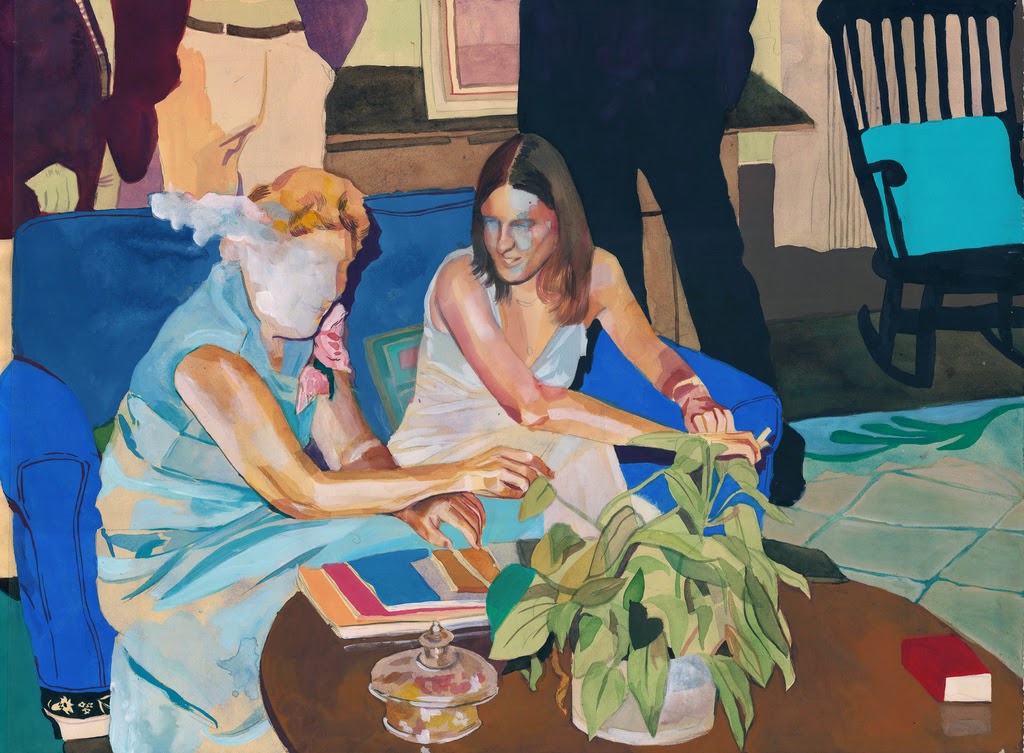
The real encouragement was found in just fostering an environment in which creativity wasn’t weird or eccentric. My mother studied study art in college. My dad wrote. My brother is an animator. My aunt is an artist and art teacher. My other aunt went to school for photography. I actually use her archive often to cull images. I hoardI’m an image collector. So in that way, the relationship is collaborative. Similarly, my mother took some paintings she made in college out of storage a few years ago and asked if I would want to paint on them, making a collaboration spanning decades. We called it Three Paintings (1981-2013). Painting over those images was incredibly difficult and nerve raking, but it taught me a lot. Nothing is precious in painting; nothing is holy. You have to risk destroying something sentimental. 


How was the experience of being an artist in residence at Artha Project?

The Artha Project really changed my practice and my life. One: it was incredible to have a group of people believing in the work I make so thoroughly. I'm forever appreciative of that. They gave me and two other artists (Rebecca Mosena and Brian Brown) that cycle a huge studio in the Brooklyn Navy Yards from August 2013 to the August of the following year. 
The space was important. Before that, I had never had a studio outside of my living room, and while I painted some larger paintings there, it was limiting. At the Navy Yards studio, a former resident left two huge 5' x 8' canvases and I made the two biggest paintings I have ever made. Conceiving of work that big, the physical time and energy, and the painting concerns all were new and challenging. 
Since leaving that space, it's been a struggle to find a studio that functions for me in a similarly productive way, but I believe the year there at the residency made me a more serious and ambitious artist.


Is it important for you to stay in touch with other artists? When do you find yourself seeking solitude?

Of course, and there are several outlets for that connection. One being the city I'm in makes it very easy to see shows and speak with other artists. That's not always the best way for me to engage in the work. Even with my close friends, I need a lot of quiet time. It's a struggle when you need that time with other people and then you need maybe double that alone to regroup energy. 


You roam different outlets for inspiration or models for later paintings. Can you sometimes sense what it is exactly that draws you to an image or scene?

You can't ever see things head-on. It's only peripherally you can begin to understand what you're getting at in painting. I do work from a variety of divergent sources. It's an unexpected and unplanned event for me to stumble on an image that resonates. When I take a step back and look at the body of work, then I can see some common threads. I'm interested in versions, re-enactments, doubling. The history of an image, whether it's degraded or transformed. How the representation of a person is influenced by all of thatmasks and obstructions. 


I had the impression that for your most recent paintings you predominantly chose muted colours. Is this a deliberate choice? Or rather, what’s the reason behind this?

Lately I'm interested in colour schemes, plans, and restrictions. How much can I get out only a few colours if no others are allowed. The less you have to work with, the more you have to push and think. Exploring simultaneous contrast and other minute colour shifts on the canvas. The work now is definitely less loud, but I think more complex and intelligent. 


Whose work are you following right now?

Heidi Hahn. She's a really excellent painter. I recently interviewed her for Packet Biweekly where she is finishing her cover residency. Ginny Casey, Kim Westfall, Kelley McNutt, Winslow Laroche, Aidan Koch... Eric Wiley's paintings are always next-levelling, but are particularly impressive right now. The work I likely follow the closest is that of my partner, Ian Lewandowski, who is a great photographer. We work through ideas, critique, and influence each other. Nicole Reber. Chris Nosenzo. Devin Morris and his project 3 Dot Zine. He works a lot with Theresa Chromati as well. Her drawings are wild. 


Do you find yourself working differently depending on the environment you’re in? If yes, can you give examples?

I'm pretty adaptableI just need a wall and a window. Usually if I'm briefly in a place and can't take my oil paints, I'll work more with gouache on paper. Or I'll focus on drawing. 


Do you plan your days ahead, or rather like to stay flexible?

I have to plan things down to the minute at this point. 


Are you listening to music while working? Do you prefer a loud/busy or silent environment?

There needs to be music playing or silence. I can't focus on anything when people are speaking. Diane Cluck is my favourite musician to listen to while I paint at the moment. 


What’s you’re favourite spot to go out for dinner?

Crock-pot at home.